On September 4, the second China-Pakistan B2B Investment Summit, the signing ceremony for the strategic cooperation on vocational education industry-education integration between China and Pakistan, and the high-level symposium were held in Beijing. Pakistani Prime Minister Shehbaz Sharif and NAVTTC Director General Amir Jan attended the event. Liu Fuyu, Deputy Party Secretary and President of the university, was invited to participate and signed a cooperation agreement with NAVTTC during the conference. Concurrently, the organizer hosted a university symposium titled “‘Human-Machine Collaboration’ Igniting a New Journey,” where Xu Xiaoyan, Party Committee Member and Vice President of the university, delivered a keynote speech.
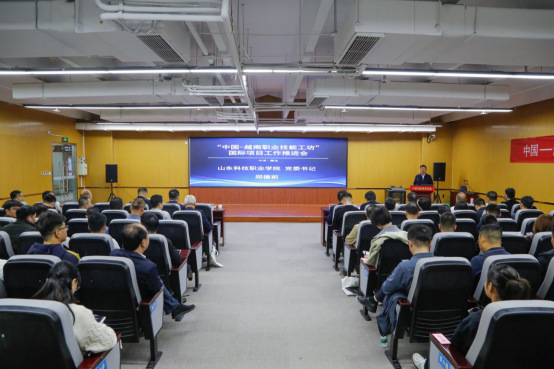
The meeting was approved by the Cabinet of the Pakistani Federal Government and officially authorized and supported by the National Vocational and Technical Training Commission (NAVTTC) of Pakistan. It aims to thoroughly implement the important consensus between China and Pakistan on deepening vocational education cooperation and contribute to building a vocational education development community between the two countries. The core objective is to strengthen the talent foundation for economic, trade, investment, and educational collaboration between China and Pakistan by deepening the integration of industry and education in the vocational education sector.
Upon the completion of the signing ceremony, representatives from China and Pakistan engaged in discussions regarding the implementation of cooperative projects. Muhammad Amir Khan introduced the functions of Pakistan's National Vocational and Technical Education Commission (NAVTEC), emphasizing its leading role in the country's vocational education sector. He noted that NAVTEC is driving the modernization of Pakistan's vocational education system and expressed hope that this signing would serve as a starting point for deepened collaboration with Chinese institutions in areas such as academic program development, faculty exchange, and skills training.
Liu Fuyu responded to Pakistan's needs by highlighting the school's strengths in overseas education, including joint program development, standard exportation, and support for enhancing international industrial capacity. This provided clarity on preliminary directions for future cooperation.
Moving forward, harnessing the "Pakistan-Ban·Mo College" as a platform, the school will deepen vocational education collaboration. Leveraging the resource advantages of its Fashion Design and Technology program cluster, the institution will continue advancing course resource sharing, joint establishment of training bases, cooperative talent cultivation, and mutual exchanges between faculty and students. These efforts will offer targeted support for the modernization of Pakistan's vocational education system while providing talent and intellectual resources for Chinese enterprises expanding into Pakistan. Additionally, this initiative will infuse new momentum into the school’s ongoing efforts to elevate its international educational standards.
(Author: Yin Jianjian; Reviewer: Xu Haiqiang)